special
Special mathematical functions in pure Go (no cgo, no assembly): the gamma family, error functions, incomplete gamma and beta functions and their inverses, Bessel functions, zeta functions, combinatorics, logistic helpers and complete elliptic integrals — with an element-wise layer over go-ndarray.
It is the numerical foundation of the go-numerics statistics library: every distribution’s cdf and quantile function is computed with these functions, so their accuracy is the product. Each function is measured in ULPs against mpmath at high precision, over its whole domain — tails, zeros, poles, huge and tiny arguments, subnormals, NaN and ±Inf — and SciPy is measured on exactly the same points.
go get github.com/go-numerics/special@v0.1.0package main
import (
"fmt"
"github.com/go-numerics/special"
)
func main() {
fmt.Println(special.Gamma(4.5)) // 11.631728396567448
fmt.Println(special.Erfc(10)) // 2.088487583762545e-45
fmt.Println(special.Ndtr(-30)) // 4.906713927148187e-198
fmt.Println(special.Ndtri(1e-300)) // -37.0470962993612
fmt.Println(special.GammaP(2.5, 1.5)) // regularised lower incomplete gamma
fmt.Println(special.BetaIncInv(2, 3, 0.975)) // a beta quantile
fmt.Println(special.Jv(2.5, 10)) // Bessel function of real order
}Arrays (github.com/go-numerics/special/nd): any real dtype in, Float32 kept
as Float32, everything else Float64; NumPy broadcasting; large arrays are
split across cores.
x, _ := ndarray.Linspace(-5, 5, 1_000_001)
p, _ := nd.Ndtr(x)
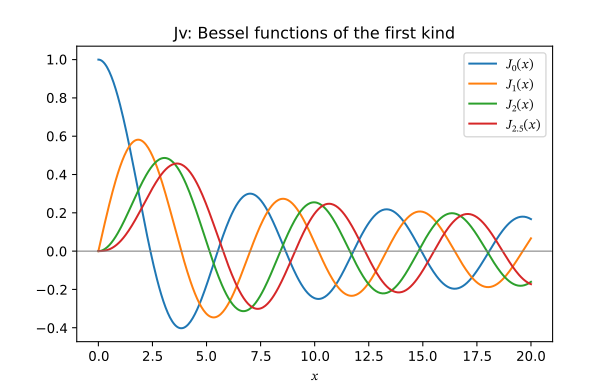
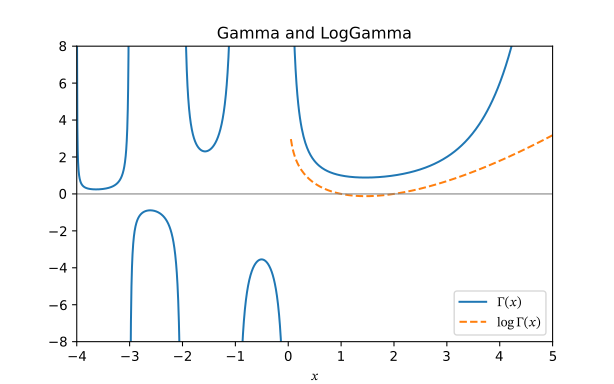
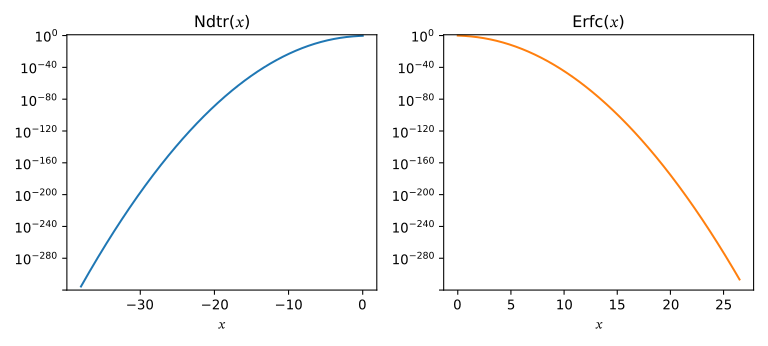
A few of them, drawn with go-plot:
package main

import (
	"fmt"

	"github.com/go-numerics/special"
	"github.com/go-plot/plot"
)

func init() { register("bessel", bessel) }

// Bessel functions of the first kind, integer and real order, with Jv.
func bessel() *plot.Figure {
	x := linspace(0, 20, 400)
	fig, axs := plot.Subplots(1, 1, plot.FigSize(6.4, 4))
	ax := axs[0][0]
	for _, v := range []float64{0, 1, 2, 2.5} {
		y := make([]float64, len(x))
		for i, s := range x {
			y[i] = special.Jv(v, s)
		}
		ax.Plot(x, y, plot.Label(fmt.Sprintf(`$J_{%g}(x)$`, v)))
	}
	ax.Axhline(0, plot.Color("gray"), plot.LineWidth(0.8))
	ax.SetTitle("Jv: Bessel functions of the first kind")
	ax.SetXLabel(`$x$`)
	ax.Legend()
	return fig
}
package main

import (
	"github.com/go-numerics/special"
	"github.com/go-plot/plot"
)

func init() { register("gamma", gamma) }

// Gamma on the real line: one curve per interval between its poles at
// 0, -1, -2, -3, so that no line is drawn across a pole.
func gamma() *plot.Figure {
	fig, axs := plot.Subplots(1, 1, plot.FigSize(6.4, 4))
	ax := axs[0][0]
	pieces := [][2]float64{{-4, -3}, {-3, -2}, {-2, -1}, {-1, 0}, {0, 5}}
	for k, p := range pieces {
		x := linspace(p[0]+0.005, p[1]-0.005, 300)
		if k == len(pieces)-1 {
			x = linspace(p[0]+0.005, p[1], 300)
		}
		y := make([]float64, len(x))
		for i, s := range x {
			y[i] = special.Gamma(s)
		}
		if k == len(pieces)-1 {
			ax.Plot(x, y, plot.Color("C0"), plot.Label(`$\Gamma(x)$`))
		} else {
			ax.Plot(x, y, plot.Color("C0"))
		}
	}
	x := linspace(0.05, 5, 200)
	lg := make([]float64, len(x))
	for i, s := range x {
		lg[i] = special.LogGamma(s)
	}
	ax.Plot(x, lg, plot.Color("C1"), plot.LineStyle("--"), plot.Label(`$\log\Gamma(x)$`))
	ax.Axhline(0, plot.Color("gray"), plot.LineWidth(0.8))
	ax.SetYLim(-8, 8)
	ax.SetXLim(-4, 5)
	ax.SetTitle("Gamma and LogGamma")
	ax.SetXLabel(`$x$`)
	ax.Legend(plot.Loc("lower right"))
	return fig
}
package main

import (
	"github.com/go-numerics/special"
	"github.com/go-plot/plot"
)

func init() { register("ndtr", ndtr) }

// The lower tail of the normal distribution and the complementary error
// function, on a log scale, down to the subnormal range of float64.
func ndtr() *plot.Figure {
	x := linspace(-38, 0, 400)
	p := make([]float64, len(x))
	for i, s := range x {
		p[i] = special.Ndtr(s)
	}
	z := linspace(0, 26.5, 400)
	q := make([]float64, len(z))
	for i, s := range z {
		q[i] = special.Erfc(s)
	}
	fig, axs := plot.Subplots(1, 2, plot.FigSize(8, 3.6))
	axs[0][0].Plot(x, p)
	axs[0][0].SetYScale("log")
	axs[0][0].SetYLim(1e-320, 10)
	axs[0][0].SetTitle(`Ndtr($x$)`)
	axs[0][0].SetXLabel(`$x$`)
	axs[0][1].Plot(z, q, plot.Color("C1"))
	axs[0][1].SetYScale("log")
	axs[0][1].SetYLim(1e-320, 10)
	axs[0][1].SetTitle(`Erfc($x$)`)
	axs[0][1].SetXLabel(`$x$`)
	fig.TightLayout()
	return fig
}
Accuracy
Measured on about 250 000 points in 419 regions over 62 functions, this package’s maximum error is at or below SciPy’s in 418 regions (the exception, K1 at small x, is a tie at 1.05 ulp). Typical maxima:
| this package | SciPy 1.18.1 | |
|---|---|---|
| Gamma, LogGamma, Beta (all regions) | 0.5–1 ulp | 3–3e15 ulp |
| Digamma near its negative zeros | 31 ulp | 2.5e17 ulp |
| Erfc to the subnormal range | 0.5 ulp | 2e13 ulp |
| Ndtr lower tail, x in [-38.5, -10) | 0.5 ulp | 1.8e12 ulp |
| Ndtri, ErfInv, ErfcInv | 0.5–0.6 ulp | 1.4–4.4 ulp (wrong at subnormals) |
| GammaP / GammaQ, a in [1e4, 1e15] | 0.6 ulp | 8.9e15 ulp |
| BetaInc, a and b in [100, 1e4) | 9 ulp | 3487 ulp |
| J0 / Y0 next to their zeros | 0.5 ulp | 3e10 / 2e12 ulp |
| Jv at x in [1e4, 1e300] | 1.7 ulp | 5e18 ulp |
The one area not solved: inverses of the incomplete beta function with a or b far below 1e-3 (both packages can be wrong there).
Full method, sources of every algorithm, negative control and limitations: Accuracy; every region: the accuracy table.
Speed
Accuracy has a price: single-threaded, a Go loop is about 3x slower than
SciPy’s C for the gamma and error-function families and 10–15x for the
Bessel functions of real order and the incomplete beta function. The nd
functions spread large arrays over the cores and beat SciPy for 21 of 31
functions measured (typically 1.5–3x on a 16-core host; e.g. Gamma 6.4 vs
13.4 ns/element, Ndtr 4.7 vs 9.0, GammaP 37 vs 137).
Method and full table: Performance.
Functions
| family | functions |
|---|---|
| gamma | Gamma, LogGamma, LogGammaSign, GammaSign, Digamma, Polygamma, Beta, LogBeta |
| incomplete gamma / beta | GammaP, GammaQ, GammaPInv, GammaQInv, BetaInc, BetaIncC, BetaIncInv, BetaIncCInv |
| error function, normal | Erf, Erfc, Erfcx, ErfInv, ErfcInv, Ndtr, Ndtri, LogNdtr |
| combinatorics | Comb, Perm, Binom, Factorial, Factorial2, LogFactorial |
| logistic, log helpers | Expit, LogExpit, Logit, Log1pExp, Xlogy, Xlog1py, LogSumExp, Softmax, LogSoftmax |
| zeta | Zeta, HurwitzZeta |
| Bessel | J0, J1, Jn, Jv, Y0, Y1, Yn, Yv, I0, I1, In, Iv, K0, K1, Kn, Kv, I0e, I1e, Ive, K0e, K1e, Kve, JnZeros |
| elliptic | EllipK, EllipKm1, EllipE |
Conventions: functions return NaN outside their domain and ±Inf at poles, as the IEEE 754 operations do; nothing panics on a float argument. Edge values follow SciPy’s where SciPy’s are mathematically sound; the exceptions are documented at each function.
Portability
Pure Go; CI runs the full accuracy suite on amd64, arm64, 386, arm (32-bit),
riscv64, loong64, ppc64le and s390x, compiles the tests for every
go tool dist list target, and holds a 100% statement-coverage gate.
One finding along the way: on amd64, Go’s math.Log (assembly) returns
about -709.09 for every subnormal argument (it should go down to -744.44);
this package never calls it on a value that can be subnormal.
License
BSD 3-Clause. Ported algorithms keep their attribution in place: Cephes (Stephen L. Moshier, distributed under BSD by SciPy) and Boost.Math (Boost Software License 1.0).
Created on by tannevaled
Modified on by tannevaled