go-numerics documentation
go-numerics is numerical computing in pure Go. Three libraries port
reference algorithms statement by statement — MINPACK, L-BFGS-B, QUADPACK, the
Runge–Kutta, Radau and BDF solvers, Cephes and Boost.Math — and test them
against recorded answers: SciPy 1.18.1 runs for optimize and integrate,
with the netlib Fortran as a second oracle, and
mpmath at high precision for special, with SciPy
measured on the same points. Where the Go code is slower than the reference,
the pages say so.
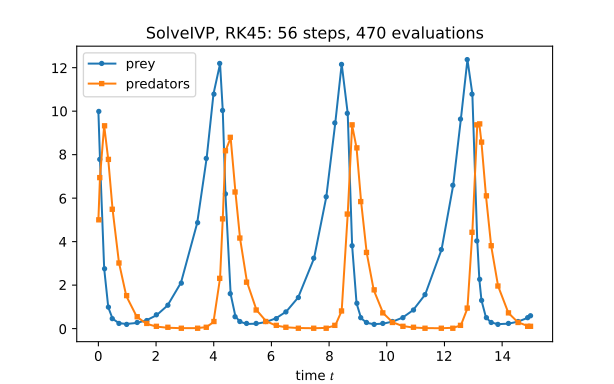
Every figure on these pages was computed by the library it illustrates and drawn by go-plot, from the code shown beside it.
The libraries
| Library | Version | What it does |
|---|---|---|
| optimize | v0.1.0 | minimisation (Nelder–Mead, Powell, CG, BFGS, Newton-CG, L-BFGS-B), scalar and system roots, nonlinear least squares, curve fitting with covariance, linear programming |
| integrate | v0.1.0 | adaptive quadrature (QUADPACK), fixed and sample rules, multiple integrals, initial value problems (RK45, RK23, DOP853, Radau, BDF, stiffness switching) |
| special | v0.1.0 | gamma, beta, error and normal functions, incomplete gamma and beta and their inverses, Bessel, zeta, elliptic integrals; an element-wise layer over go-ndarray |
Install
go get github.com/go-numerics/optimize@v0.1.0
go get github.com/go-numerics/integrate@v0.1.0
go get github.com/go-numerics/special@v0.1.0
Each module needs Go 1.27.2 or later and is pure Go (CGO_ENABLED=0). Each
one’s CI runs its tests on amd64 and arm64 and under emulation on riscv64,
loong64, ppc64le and s390x; integrate and special add 386 and 32-bit arm.
What each library’s pages hold
| Library | Pages |
|---|---|
| optimize | overview · design · performance |
| integrate | overview · design · verification · quadrature table · ODE table · performance |
| special | overview · accuracy · accuracy table · performance · performance table |
Honest weak points
Where these libraries are slower than the reference, their own measurements say so, and so do these pages:
optimize:curve_fiton 10⁴ points is slower than SciPy’s (0.67× with LM, 0.77× with TRF); the gap is in the solver’s workspace handling (performance).special: single-threaded, a Go loop is about 3× slower than SciPy’s C for the gamma and error-function families and 10–15× for the Bessel functions of real order and the incomplete beta function; thendfunctions, spread over the cores, beat SciPy for 21 of 31 functions measured (performance).
Built on
go-ndarray (arrays: curve-fit data,
covariances, LP matrices, ODE solutions and the element-wise special/nd
layer). The figures are drawn by go-plot,
and a go-notebook cell can use all
of it.
Created on by tannevaled
Modified on by tannevaled